Grays Bay is located in the Western portion of the Northwest Passage (NWP) between Cambridge Bay and Kugluktuk.
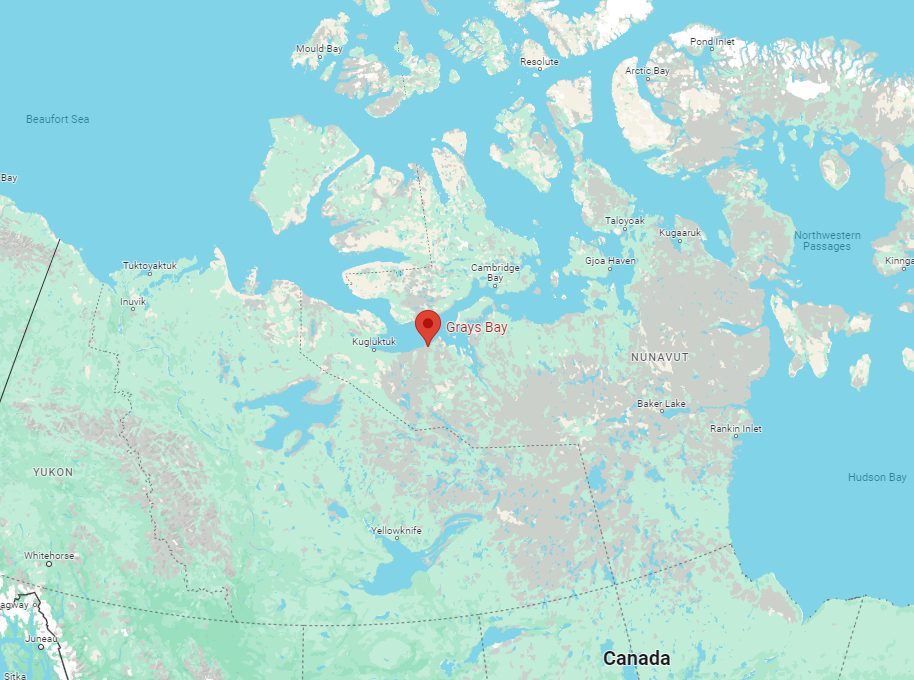
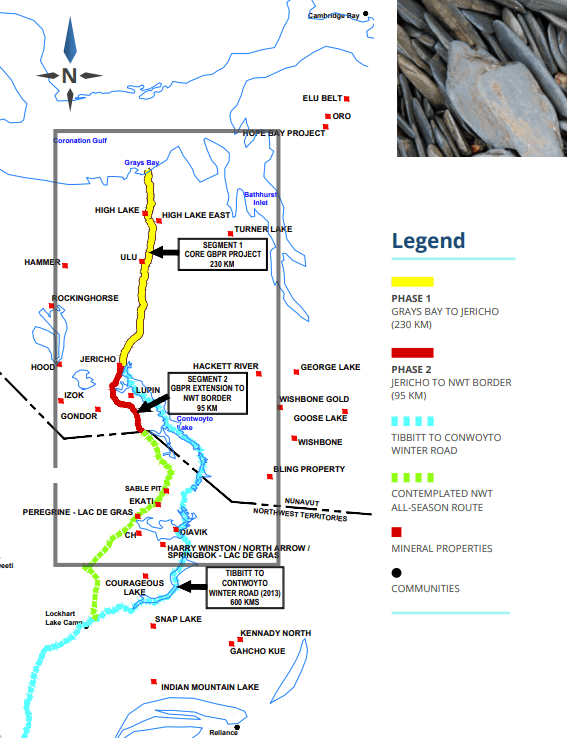
From Grays Bay, the Road and Port Project would first construct a road connecting Nunavut to the rest of Canada via Northwest Territories (NWT) road and rail networks. It would then build a deep-water port in Grays Bay, connecting the Kitikmeot region – a region host to some of the world’s most undeveloped zinc and copper resources at the Izok and High Lake Deposits – south of Grays Bay, to the NWP.
Phase 1:
230 kilometre all-season road connecting Grays Bay with Contwoyto.
Phase 2:
95 kilometre all-season road to connect Phase 1 road to an all-season road currently under development by the Government of the NWT, providing all-season access to the North American road network at Yellowknife.
The project was initially launched by the Kitikmeot Inuit Association (KIA) and the Government of Nunavut (GN). In 2018 the proposal was rejected leading GN to withdraw from the project, and in 2023, KIA would also withdraw.
A subsidiary of KIA, the West Kitikmeot Gold Corporation (WKR), became the projects main proponent and currently holds mineral exploration rights to five of the properties along the proposed corridor.
Upon completion, this project would become the most capable deep-water port between Nome, Alaska and Nuuk, Greenland. The port would be capable of loading Panamax-class bulk ore carriers, and docking and refueling large vessels transiting the NWP. The port would have an adjacent small craft harbor for community use.
Additional infrastructure to be built around the port is expected to include:
- Airstrip
- Fuel Farm
- Concentrate storage and handling facilities
- Utilities (power, water, wastewater, landfill)
- Maintenance shops
- Warehousing
- Accommodations
- Administrative offices
GBRP has the potential to generate significant employment and financial benefit to the region through the development of infrastructure, maintenance and operation of the facilities, and the resulting increase in shipping and mining activity in and through the NWP.
A deep-water port in the Canadian Arctic would significantly increase vessel traffic to the region, providing fuel and refuge for vessels and transits of all types. While the economic benefits are significant, the increase in vessel traffic could open the region to numerous potential security considerations – cyber attacks on the port infrastructure, drug and human trafficking, espionage, sabotage, and more. Most importantly, Canada lacks the capacity to operate in the region year-round – neither the Canadian Coast Guard nor Royal Canadian Navy have year-round icebreaking capabilities – which will leave the ports operating season within the Canadian Coast Guard’s icebreaking season. Countries like Russia have multiple nuclear icebreakers, and China’s nuclear icebreaking capacity is allegedly in development. Developing year-round icebreaking capacities takes significant time and effort, and Canada has a lot of work to do if we are going to compete on a global scale.
 Canadian Arctic Security
Leave a comment